EDM electrode selection should follow the mold feature and its acceptance requirements. Choosing graphite or copper by material price alone leaves out electrode manufacture, machining conditions, wear, finishing and replacement needs. Ask the moldmaker to propose a complete route for each demanding feature, including roughing and finishing responsibilities, rather than requesting one electrode material for the entire tool without a technical reason.
This FUMING guide helps engineering and purchasing teams compare electrode proposals for mold making projects. It concerns shaped electrodes used in sinker EDM. Wire EDM uses a different electrode arrangement and should not be confused with this selection exercise. The review examples are hypothetical and do not state that FUMING owns a particular EDM machine or guarantees a particular finish.
What the electrode choice must accomplish
Sinker EDM removes material from an electrically conductive workpiece through controlled discharges across a gap between the electrode and the workpiece. The electrode and its machining strategy help produce the intended cavity geometry. The process is not a direct mechanical stamping operation, and the electrode should not simply be treated as an exact-size solid copy pressed into the mold steel.
Makino’s explanation of ram EDM and finishing describes the discharge process and the importance of the gap and dielectric. Its discussion is tied to particular technologies, so it should not be converted into a universal modern machine capability claim. For procurement, ask the proposed supplier how its actual equipment and process address the required feature.
Begin with a feature list: deep pockets, narrow slots, small internal radii, ribs, texture areas and surfaces intended for later polishing. Mark the steel grade and condition, dimensional requirements and final surface requirement. The mold design review checklist provides a broader framework; the electrode review should resolve the specific EDM features within that plan.
Compare graphite grades, not just the word graphite
Graphite electrodes are available in different grades with different property combinations. Entegris explains particle size, strength and the role of copper impregnation in its EDM-C3 material discussion. This illustrates why “graphite electrode” is not a complete material specification. It does not establish that a named commercial grade is required for your mold.
Ask the moldmaker to identify the proposed grade or controlled material designation and explain its relevance. A supplier should be able to distinguish the choice for a broad roughing feature from the choice for a delicate finishing detail. If an alternative grade is offered, request a feature-specific justification and any validation needed before substitution. Similar marketing descriptions are weaker evidence than an agreed material and process record.
Compare copper through the actual finishing route
Copper can be a useful candidate for fine finishing applications, but it should be evaluated with the machine, work material, geometry and target surface. The relevant question is whether the proposed route delivers the accepted mold feature reliably. A material comparison that ignores electrode preparation, deburring where needed, setup and downstream finishing can misrepresent the practical cost.
Ask for the same deliverables when comparing a copper proposal with a graphite proposal. Use the same cavity definition, steel condition, final surface and inspection expectations. Otherwise, a faster quoted burn may simply leave more work for polishing or another operation. Make those exclusions visible before comparing totals.
| Decision area | Graphite proposal: clarify | Copper proposal: clarify |
|---|---|---|
| Fine or fragile geometry | Grade, detail strength and handling plan | Detail manufacture and preparation method |
| Surface requirement | Finishing strategy and subsequent work | Achievable surface on the stated geometry and equipment |
| Wear management | Allowance, replacement criteria and electrode count | Allowance, replacement criteria and electrode count |
| Quotation scope | Electrode manufacture, inspection, setup and burn scope | The same scope, including any additional preparation |
| Repeat work | Material identity and retained manufacturing records | Material identity and retained manufacturing records |
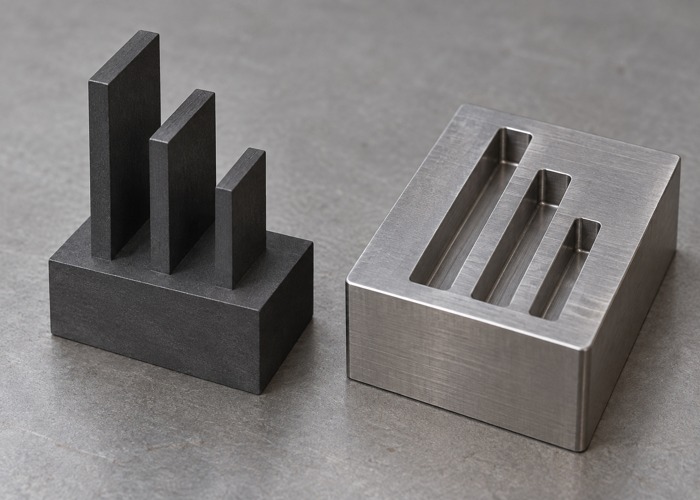
Give narrow ribs and deep features their own review
A thin electrode detail may create risk before the EDM cycle even starts. It must survive manufacture, inspection, storage, installation and handling. Ask whether splitting a complex electrode into separate operations would make the feature easier to control, and what additional alignment or setup requirements that would introduce. The answer should be tied to the design rather than a general preference for fewer electrodes.
Consider a hypothetical mold insert containing a large open pocket and several narrow slots. One quotation may combine the geometry in a single electrode; another may separate the broad removal and fine details. Compare how each approach handles inspection access, replacement after damage and the verification of slot geometry. Do not assume that the smaller electrode count automatically means the lower completed-tool cost.
For features that might be milled instead, the tool reach and deep pocket design guide helps frame the alternative process discussion. A useful moldmaking review considers where milling, EDM and later finishing fit together, instead of treating every difficult feature as an isolated EDM decision.
Separate roughing performance from accepted surface quality
Metal removal rate, electrode wear and surface finish are different performance measures. Sodick discusses these performance dimensions for a specific machine in its AL60G product overview. Such equipment information is useful context, but does not establish the capability of an unspecified supplier or part. A roughing result does not automatically demonstrate a finishing result, and a fine-looking surface does not establish that all critical dimensions are correct.
Have the supplier explain which operation establishes the final dimensions and which establishes the final surface. Specify where polishing or texturing follows EDM, and identify edges, shutoffs or details that must be protected during that work. Use the mold surface finish guide to align tooling requirements with the appearance of the molded part.
If surface integrity is important to the application, state the applicable acceptance requirement and how it will be assessed. Avoid accepting or rejecting a process only because a sample looks shiny. Request relevant evidence for the actual requirement, with a clear distinction between a visual sample, a roughness measurement and any additional verification specified by the engineering team.
Compare the complete quotation
Entegris discusses application limits and differences in wear in its EDM-1 graphite article. This reinforces the need to evaluate the chosen grade against the actual work material and machining conditions. For an independent buyer’s comparison, use a common quotation template rather than assigning an unsupported percentage advantage to either material.
- Electrode design, material designation and manufacturing scope.
- Inspection and identification of each electrode or set.
- Roughing and finishing operations included in the price.
- Planned electrode quantities and assumptions about replacements.
- Machine setup and any separate feature operations.
- Polishing, texturing and inspection after EDM.
- Spare ownership, retention period and repeat-order arrangements.
A supplier may have a sound reason to quote a higher-priced electrode material if it supports a better overall route. Ask for the reasoning and the assumptions, not a guaranteed saving copied from a material brochure. For an unfamiliar or demanding feature, agree whether a representative trial is needed before the main tool work proceeds.
Keep the records needed for repair and repeatability
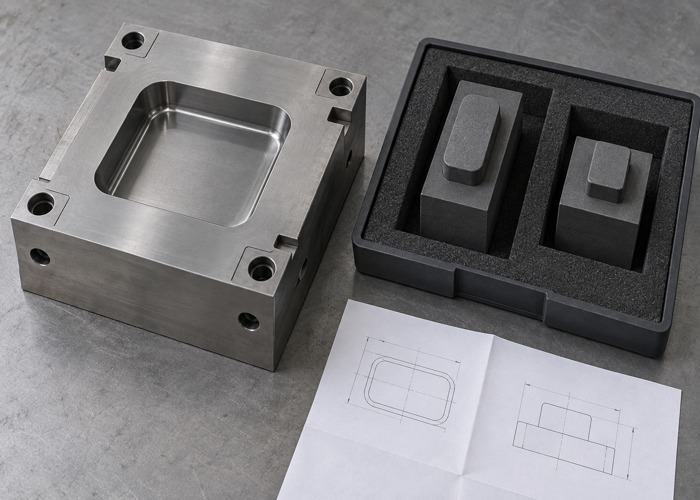
Define what is retained after tool acceptance. Useful records include electrode identification, controlled geometry, material designation, inspection references and the relationship between an electrode and the mold feature it produces. Agree ownership and access for retained spares. A spare that cannot be matched to the approved revision may be less useful than a clear, reproducible manufacturing record.
Sodick’s discussion of electrode production and sinker workflows highlights electrode quality and replacement planning. Treat such references as background for questions, while requiring the supplier’s proposal to reflect its own process and your tool. No external case study establishes performance for an untested mold.
Frequently asked questions
Is graphite always cheaper than copper?
No universal total-cost answer follows from the material name. Compare the complete scope, accepted surface and dimensional requirements, electrode quantities and downstream work. Obtain a project-specific quotation with explicit assumptions.
Can the buyer require one material for every electrode?
A contract can define a material requirement, but the engineering reason should be clear. If no such constraint exists, invite the moldmaker to propose materials by feature and explain the tradeoffs. Keep approval requirements for later substitutions explicit.
What should accompany an EDM-related mold inquiry?
Send the part and mold information available, highlight difficult features, and identify steel, finish, dimensional and documentation requirements. Include expected tool use and spare needs. Contact FUMING through the quotation form to discuss these requirements as part of the complete moldmaking scope.