

A single manufacturing error in a high-precision component can cost tens of thousands of dollars in scrapped parts, delayed shipments, and lost contracts — and for industrial buyers, that risk alone is enough to rethink who they trust.
Specialization in high-stakes manufacturing isn’t a niche strategy — it’s the difference between consistent quality and costly failure.
The generalist trap is real, and it’s expensive. Facilities that spread their capabilities too thin across too many processes struggle to develop the deep process knowledge that precision industries demand. In sectors where tolerances are measured in microns, a broad-but-shallow approach introduces variability that compounds across production runs. As research on industry specialization consistently shows, focused expertise produces measurably better outcomes — not just for service quality, but for the bottom line.
CNC Machining illustrates this dynamic clearly. Shops that dedicate their engineering talent, tooling investment, and quality systems to a defined set of materials and geometries don’t just produce better parts — they produce them faster and with fewer defects. That operational precision translates directly into customer uptime. When a critical component arrives on spec, on time, and the first time, downstream production lines keep running. That reliability isn’t accidental; it’s the product of accumulated, specialized knowledge that generalist operations simply can’t replicate. Understanding how precision manufacturing is evolving helps explain why leading industrial buyers are actively seeking partners with narrower, deeper expertise rather than broader, shallower catalogs.
The shift away from generalist suppliers isn’t just about risk mitigation — it’s about finding partners who drive measurable technical improvements. Specialization, as we’ll explore, means something specific in the context of rapid prototyping and industrial production, and understanding that distinction is the starting point.
Defining Company Specialization in the Context of Rapid Prototyping
Specialization in industrial manufacturing means deliberately concentrating resources, expertise, and processes around a defined set of capabilities — rather than attempting to serve every production need equally.
As research on factory specialization confirms, focusing on core activities sparks innovation and makes organizations measurably stronger. In rapid prototyping, that principle has a direct operational impact.
Specialization transforms how industrial teams work — not just what they produce.
Service provider vs. technical partner. A generalist service provider accepts a drawing, runs the job, and ships the parts. A specialized technical partner engages earlier — analyzing geometry, flagging design-for-manufacturability issues, and recommending process adjustments before material is ever cut. That upstream involvement is where specialization creates real competitive distance. For industrial equipment manufacturers, the difference often shows up in iteration cycles: a technical partner can compress prototype revisions from weeks down to days by anticipating problems that a generalist would only discover after the first failed run.
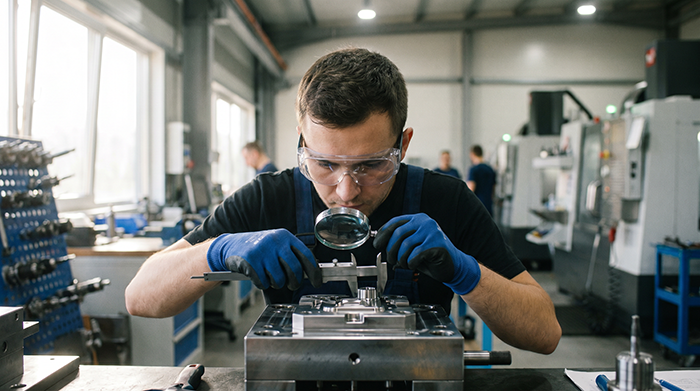
Core activity concentration. When a manufacturer focuses tightly — on, say, precision Sheet Metal Fabrication alongside CNC work — they build process depth that a generalist simply cannot replicate. Tolerances tighten. Fixture setups improve. Material behavior becomes predictable rather than variable. Teams working within a narrow capability set develop pattern recognition that accelerates decision-making at every stage of production. For manufacturers with complex geometries or multi-stage assemblies, this depth is the difference between hitting a prototype deadline and missing it.
Innovation follows concentration. Specialized teams iterate their own processes continuously, which is why complex parts often benefit from advanced multi-axis approaches that only emerge within shops committed to pushing capability boundaries. Generalists optimize for volume; specialists optimize for precision and speed simultaneously.
That pursuit of precision — particularly within CNC machining — is where specialization becomes most tangible on the shop floor.
CNC Machining and Precision: The Core of Industrial Specialization
CNC machining is the technical backbone of industrial specialization — the process where tight tolerances separate functional components from expensive scrap.
In precision manufacturing, tolerances measured in microns are not a luxury; they are the baseline requirement for components that must perform under extreme load, heat, and stress.
Precision as a Non-Negotiable Standard
For industrial equipment manufacturers, CNC precision isn’t optional. A component machined even marginally outside specification can cause cascading failures downstream — affecting assembly timelines, product performance, and ultimately customer trust. In practice, industries such as aerospace, medical devices, and heavy equipment routinely demand tolerances of ±0.001 inches or tighter. Achieving that level of repeatability requires more than advanced machinery; it requires operators who have spent years developing deep familiarity with specific materials and cutting strategies. As factory specialization research consistently shows, concentrated expertise produces measurable quality gains that generalist operations struggle to replicate.
Specialized Operators and Material Efficiency
One underappreciated benefit of CNC specialization is its direct impact on material waste. Specialized operators don’t just run programs — they optimize toolpaths, anticipate material behavior, and catch errors before a single chip is cut. What typically happens in generalist shops is that operators rotate across unfamiliar jobs, increasing the probability of setup errors and scrapped stock. A specialist working daily with, say, hardened steel or titanium alloy develops an intuitive command of feed rates and tooling selection that dramatically reduces waste and rework cycles. This expertise is a genuine competitive cost advantage, not just a quality marker.
Bridging CNC into a Broader Production Strategy
CNC machining rarely operates in isolation. In a well-structured rapid production environment, it feeds directly into downstream processes — and understanding those dependencies is where specialization compounds its value. Explore machining and prototyping resources to see how CNC integrates within a full manufacturing workflow. As production scales, the relationship between precision-machined components and processes like Injection Molding becomes increasingly critical — a topic that shapes how manufacturers think about tooling, cycle times, and durability in the next phase of production.
The Role of Mold Making and Injection Molding in Scaled Production
Mold making and injection molding are where prototype intent meets production reality — and where specialization directly determines whether a design scales or stalls.
The technical demands of industrial mold making go far beyond simple cavity cutting. Achieving consistent wall thickness, proper gate placement, and controlled cooling channels requires engineering judgment that only comes from focused, repeated experience. In practice, a poorly designed mold produces parts with sink marks, warping, or flash — defects that compound at scale and drive up cost-per-unit fast. Companies that narrow their focus around mold engineering are better positioned to deliver the technical improvements that prevent these failures, as IsharaShehan Consultancy has noted in the context of industrial specialization.
Injection molding is not a commodity process. Material selection — whether engineering-grade nylon, glass-filled polypropylene, or high-impact ABS — changes how a mold must be designed and how it will perform across thousands of cycles. Specialized teams account for material shrinkage rates, ejection force requirements, and parting line placement before a single tool path is cut. Generic providers frequently overlook these variables, which is exactly why specialized shops consistently outperform on dimensional accuracy and cycle life.
Balancing speed and durability in mold design is one of the most persistent engineering trade-offs in manufacturing. Softer aluminum tooling cuts faster and costs less upfront but wears quickly under high-volume runs. Hardened P20 or H13 steel tooling demands more lead time but delivers hundreds of thousands of consistent shots. The right choice depends on production volume, part geometry, and how closely tolerances must be held over time. Teams that handle these decisions daily — rather than occasionally — apply pattern recognition that genuinely shortens development cycles.
- Reduced dimensional variation across high-volume production runs
- Extended tool life through optimized cooling and venting strategies
- Lower scrap rates driven by accurate shrinkage and gate calculations
- Faster ramp-up from prototype to full production volumes
- Better material compatibility through process-specific mold hardness selection
It’s also worth noting that modern mold development increasingly incorporates 3D Printing for rapid prototype tooling inserts — a bridge technology that lets teams validate cavity geometry before committing to full steel tooling. That intersection of digital fabrication and traditional mold engineering points directly toward how sheet metal fabrication and additive manufacturing are reshaping the broader prototyping workflow.
Sheet Metal Fabrication and 3D Printing: A Dual Approach to Prototyping
Sheet metal fabrication and 3D printing aren’t competing technologies — they’re complementary tools that, when deployed strategically, compress development cycles and unlock genuine Value-Added Solutions for industrial equipment manufacturers.
The choice between the two comes down to geometry, volume, and material requirements. Sheet metal fabrication excels where structural integrity and end-use material properties matter most. Laser cutting, punching, and press brake forming produce parts with tight dimensional tolerances at relatively low per-unit cost, making the process ideal for enclosures, brackets, and load-bearing structural components. In practice, sheet metal becomes the clear choice once a design is validated and you need consistent, repeatable parts — typically at quantities above a few dozen units.
3D printing, on the other hand, earns its place in the early prototype phase. Additive manufacturing allows engineers to iterate on complex geometries — internal channels, organic forms, consolidated assemblies — without the tooling investment that sheet metal dies or punch fixtures require. Industrial-grade systems go far beyond desktop printers: selective laser sintering (SLS), direct metal laser sintering (DMLS), and multi-jet fusion platforms produce functional parts from engineering-grade nylons, titanium, and tool steels. That hardware specialization matters — an SLS machine running production-intent nylon behaves very differently from a consumer FDM unit, and treating them as equivalent is a common and costly mistake.
| Factor | Sheet Metal Fabrication | 3D Printing |
|---|---|---|
| Best for | Structural, high-volume parts | Complex geometry, low-volume prototypes |
| Lead time | 3–10 business days | 1–5 business days |
| Material range | Steel, aluminum, stainless | Polymers, metals, composites |
| Tooling cost | Moderate (dies, fixtures) | Minimal |
| Dimensional accuracy | ±0.005″ typical | ±0.010″–0.020″ typical |
Rapid prototyping workflows built around both methods reduce lead times by routing each part to the right process from the start — rather than defaulting to a single technology. If you’re exploring how these workflows apply to a specific project, reviewing common rapid prototyping questions can help clarify process selection early. That kind of upfront routing decision feeds directly into the broader conversation about how specialized capabilities combine into something greater than individual processes — which is exactly where the next layer of competitive advantage begins.
Value-Added Solutions: Beyond the Basic Part
Company specialization reaches its highest form when a manufacturer moves beyond delivering individual parts and begins offering integrated, end-to-end solutions that reduce friction across the entire production chain.
A “value-added solution” in industrial manufacturing means more than simply cutting a part to spec. It encompasses every downstream service that transforms raw components into ready-to-deploy assemblies — finishing operations like anodizing, powder coating, and heat treatment; sub-assembly and final assembly; dimensional inspection and functional testing; and even kitting for direct delivery to the production floor. Each of these disciplines carries its own technical depth. A partner who treats them as afterthoughts will introduce variability that compounds downstream.
Assembly, finishing, and quality control are specialized disciplines in their own right — not administrative tasks that any shop can absorb without dedicated expertise. Tight-tolerance assembly requires fixtures, trained technicians, and controlled environments. Surface finishing directly affects corrosion resistance, fatigue life, and dimensional conformance. Quality control, when done well, is a data-generating process that feeds back into process improvement rather than functioning purely as a pass/fail gate. Shops that have invested in precision-driven manufacturing processes understand that the final part’s integrity depends on every stage being held to the same standard.
The supply chain benefit is equally significant. Every additional vendor in a manufacturing sequence is a handoff — and handoffs carry risk. Lead time uncertainty, communication gaps, and quality disputes multiply with each party involved. An integrated specialist consolidates those touchpoints. What might require coordination across four or five suppliers compresses into a single accountable relationship.
“Consistent brand tone of voice can increase brand recall by up to 20%” — and the same principle applies operationally: consistent process ownership across assembly, finishing, and QC builds the kind of manufacturing memory that general vendors simply cannot replicate. (Nielsen Norman Group)
The right manufacturing partner isn’t just a vendor — they’re a systems integrator. Knowing how to identify one is the next critical step, and it starts with asking the right questions.
To Specialize or Not: Evaluating Your Manufacturing Partners
Choosing the right vendor in industrial equipment manufacturing often comes down to one underrated skill: knowing how to measure specialization before you sign a contract.
A useful mental model is a 0–10 specialization scale — where 0 represents a shop that machines anything for anyone, and 10 represents a facility so dialed into a specific process or industry that it operates almost as an extension of your engineering team. Most qualified partners sit between 6 and 9. Anything below 5 should trigger serious scrutiny.
When vetting a potential CNC or molding partner, the right questions surface capability gaps quickly:
- What percentage of your work falls within our industry or part type? A genuine specialist can answer without hesitation.
- Can you show process documentation or quality records from similar projects? Vague portfolios are a warning sign.
- What tolerances do you hold consistently, and how do you verify them? Specialists cite real numbers; generalists hedge.
- Do you offer precision turning or multi-axis work as a core capability, or as an occasional add-on? The answer reveals operational depth.
- Who owns quality control — a dedicated team or the operator? Specialization typically means dedicated QC.
According to Hinge Marketing, assessing specialization levels is a defining trait of high-growth firms — meaning the sharpest buyers are already doing this audit systematically.
Red flags from generalist manufacturers include vague lead time commitments, surface-level material knowledge, inconsistent tolerances across batches, and an inability to discuss your industry’s compliance requirements. If a vendor can’t speak fluently about your application, they’re learning on your timeline and your budget.
Evaluating your partners with this kind of structured rigor isn’t just good procurement practice — it’s the foundation of a supply chain that actually scales. And as the next section explores, that discipline pays compounding dividends over time.
The Bottom Line: Why Specialization is Your Best Strategic Move
Specialization is not just a business philosophy — it is the most reliable path to sustainable competitive advantage in industrial equipment manufacturing.
As previous sections have established, deep expertise reshapes everything from tooling decisions to value-added service delivery. But the cumulative argument is worth stating plainly: a specialized manufacturing partner eliminates the hidden costs, delays, and quality gaps that generalist vendors routinely introduce. According to Shop Marketing Pros, specializing could be the best thing you ever do for your business growth — and the evidence across industrial sectors consistently supports that view.
Reduced costs start with fewer mistakes. When a manufacturing partner operates within a clearly defined technical domain, rework rates drop. Engineers who spend years on a narrow set of processes develop an instinct for tolerances, material behavior, and failure points that generalists simply cannot replicate. That instinct translates directly into first-pass quality — and first-pass quality means fewer rejected parts, shorter lead times, and lower total project costs.

Technical depth drives innovation, not just execution. In practice, the manufacturers pushing industrial design forward are not the ones offering the broadest catalog — they are the ones with the narrowest focus and the deepest process knowledge. This is especially visible in rapid prototyping and production, where tight iteration cycles demand both speed and precision simultaneously. A partner with genuine expertise compresses that cycle without trading accuracy for throughput.
Choosing a specialized partner like Oxrapid means gaining access to focused CNC capability, rigorous process controls, and an engineering team aligned entirely around industrial equipment outcomes. Whether you are sourcing complex machined components or exploring CNC applications for a new product line, that depth of specialization is the differentiator that compounds over time.
Key Takeaways
- Specialization reduces total project costs by improving first-pass quality and eliminating expensive rework cycles that generalist vendors routinely generate.
- Technical expertise is the primary engine of industrial innovation, enabling manufacturers to push design limits during rapid prototyping and production without sacrificing accuracy.
- Specialized partners offer compounding advantages — process knowledge, application-specific tooling, and engineering alignment that a broad-scope vendor cannot replicate.
- Evaluating a manufacturing partner means looking beyond price — the right specialist reduces risk, accelerates timelines, and delivers measurable long-term value across the entire production lifecycle.
Frequently Asked Questions About Industrial Specialization
Specialization in manufacturing is not a niche concept — it is the structural foundation that separates high-performing industrial suppliers from generic vendors.
What is company specialization in manufacturing?
As defined by Collins Dictionary and Cambridge, specialization is the concentration on a narrow range of products or services. In manufacturing, this means a company deliberately limits its scope to build deeper process knowledge, tighter tolerances, and faster turnaround within a defined domain. Rather than offering everything to everyone, specialized manufacturers invest their resources where they perform best — and that focus compounds into measurable competitive advantage over time.
Why is CNC machining considered a specialized field?
CNC machining requires a convergence of programming expertise, materials knowledge, and precision tooling that generalist shops simply cannot replicate at scale. The global CNC machining market is projected to reach $128.41 billion by 2032, growing at a 5.4% CAGR — a trajectory driven entirely by demand for tighter tolerances and complex geometries. Dedicated CNC specialists, equipped with 50+ high-precision machines, consistently outperform generalist shops on both cycle time and repeatability. Explore what precision-focused machining capability looks like in practice.
How does mold making impact production speed?
Mold making is one of the most time-sensitive bottlenecks in industrial production. A specialized mold maker maintains calibrated tooling, proven material workflows, and iterative design feedback loops that compress lead times significantly. In practice, manufacturers that treat mold making as a core competency — rather than an outsourced afterthought — consistently hit production milestones faster and with fewer costly revisions.
What are value-added solutions in industrial equipment?
Value-added solutions extend beyond raw part production to include design consultation, finishing, assembly support, and quality certification. For industrial equipment buyers, these capabilities reduce vendor count, streamline communication, and lower total procurement cost — making a specialized partner far more strategic than a transactional one.


