

The High Cost of the ‘Prototyping Gap’
A prototype that can’t survive the journey to production isn’t a prototype — it’s an expensive dead end. For manufacturers in aerospace, automotive, and medical device sectors, the real budget killer isn’t the prototype itself. It’s the invisible friction that builds up every time a design crosses from a prototyping shop to a production floor.
That friction has a name: the prototyping gap. When engineers rely on siloed vendors — one partner for development, another for volume manufacturing — they face re-tooling costs, duplicated programming hours, and the slow erosion of geometric accuracy. Design for manufacturability (DFM) breaks down fast in these environments because the team validating the prototype is rarely the team cutting the final parts. Feedback loops stretch. Tolerances drift. Budgets bleed.
Producers are replacing stand-alone prototyping labs with integrated cells that support short-run production, slashing design cycles and tooling budgets. — Mordor Intelligence
This shift is redefining what precision custom CNC machining services actually deliver. Rather than handing off a design and hoping for continuity, manufacturers increasingly demand a single, connected workflow — from first article to full run. Platforms built around instant manufacturability feedback are accelerating that transition significantly.
The question isn’t whether integration matters. It’s how the digital thread holds together — starting with CNC machining itself.
Precision CNC Machining: The Digital Thread from CAD to Scale
The most powerful argument for CNC machining isn’t just speed — it’s continuity. Unlike additive processes that require material reformulation or tooling overhauls when moving from prototype to production, CNC machining operates on a single, unbroken digital thread. The same CAD/CAM files used to cut your first prototype drive the machine at unit 10,000, eliminating the variability that quietly kills so many scaling programs.
This matters enormously in practice. When engineering teams don’t have to re-translate design intent between stages, tolerance drift becomes a manageable variable rather than an invisible threat. CNC machining allows for a seamless transition from prototype to mass production precisely because the toolpaths, feeds, and offsets carry forward without reinterpretation.
Material Versatility: One Platform, Infinite Possibilities
CNC machining’s real competitive strength lies in its compatibility with the full spectrum of production-grade materials — from aerospace aluminum alloys and titanium to engineering plastics and hardened tool steels. This extends naturally into custom sheet metal fabrication, where laser-cut and CNC-bent components must match machined counterparts to exacting tolerances. Whether you’re prototyping a titanium bracket or a stainless enclosure, the same platform scales without compromise.
For complex geometries — turbine housings, suspension knuckles, surgical implants — 5-axis milling is the decisive capability. It machines undercuts, compound curves, and deep cavities in a single setup, reducing fixturing errors that accumulate across multiple operations. Explore how 5-axis capabilities integrate across processes to understand the full scope of what modern machining centers deliver.
Typical CNC tolerance benchmarks across production runs:
- General machining: ±0.05mm
- High-precision milling: ±0.01mm
- Aerospace/medical grade: ±0.005mm, maintained from unit 1 to unit 10,000
Precision at scale isn’t a luxury — it’s the baseline expectation that separates functional prototypes from production-ready components. Understanding how this precision is achieved domestically sets the stage for a larger question: can the same standard be met at significantly lower cost through global manufacturing ecosystems?
The China Advantage: Beyond Low Cost to Ecosystem Efficiency
Cost savings get the headline, but they’re rarely the whole story. According to PTSMAKE, Chinese CNC machining services can deliver 30% to 50% cost savings compared to Western suppliers — without compromising on dimensional tolerances or material integrity. Understanding why this is possible reveals something more strategically valuable than a cheaper invoice.
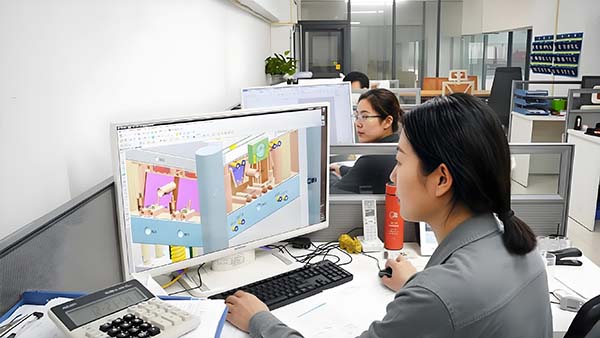
The real driver is ecosystem density. In manufacturing hubs like Shenzhen, Dongguan, and Suzhou, raw material suppliers, specialist subcontractors, surface finishers, and quality inspectors operate within a tightly compressed geographic radius. What might require four separate vendor relationships in a Western supply chain can often be handled within a single industrial park in China. That compression eliminates lead time, reduces logistics overhead, and creates compounding efficiencies at every stage of production.
This matters even beyond CNC work. When a project moves from prototype into low volume injection molding or bridge tooling, having precision mold-making capabilities nearby — rather than distributed across time zones — keeps the entire program on schedule.
Here’s how the two ecosystems compare at a structural level:
| Factor | Western Ecosystem | Chinese Ecosystem |
|---|---|---|
| Average lead time | 3–6 weeks | 1–3 weeks |
| Supply chain proximity | Distributed | Geographically concentrated |
| Cost structure | Higher labor + overhead | Optimized at scale |
| ISO certification access | Widely available | Increasingly standardized |
| Post-processing integration | Often outsourced | Frequently in-house |
ISO-certified quality control is no longer a differentiator — it’s the baseline expectation. Reputable Chinese manufacturers now operate under ISO 9001 and, in regulated sectors, AS9100 or ISO 13485 frameworks. Navigating this landscape requires due diligence, but the infrastructure for rigorous quality assurance is firmly in place.
The firms that leverage this ecosystem most effectively treat it as a strategic capability, not just a cost lever. That’s a mindset shift best illustrated through real-world examples — which is exactly where the next section picks up.
Case Studies in Integrated Manufacturing: Tetra Pak and Master Eggs
Real-world partnerships reveal what spec sheets can’t: how integrated manufacturing holds up under pressure. Two examples from the food processing and packaging industries illustrate what the journey from rapid prototyping to mass production actually looks like at scale.
Tetra Pak China: Localized Precision at Industrial Volume
Tetra Pak’s approach in China isn’t simply about adapting global designs for local markets — it’s a masterclass in precision-at-scale. By investing in localized manufacturing partnerships, Tetra Pak ensures that packaging components meet tight dimensional tolerances across enormous production runs. The takeaway? Localization reduces variability. When precision components are sourced regionally, lead times shrink and quality feedback loops tighten — two factors that matter enormously once a product exits prototype validation and enters high-volume production tooling.
Master Eggs x Sanovo: Confidence Through Specialization
The collaboration between Master Eggs and Sanovo Group illustrates a different but equally instructive model. Rather than managing equipment in-house, Master Eggs leaned on Sanovo’s specialized processing expertise to maintain consistent output at high volumes. Specialized partnerships don’t just reduce cost — they transfer institutional knowledge that would take years to build internally.
What Mid-Market Firms Can Take Away
Both cases reinforce one principle: scaling through specialized precision machining partners outperforms vertical integration for most mid-market firms. You get speed, expertise, and accountability without the capital overhead.
Key Takeaway: The most scalable manufacturers aren’t necessarily the biggest — they’re the most strategically connected. Choosing the right partner at the prototype stage shapes every production decision that follows.
As manufacturing grows smarter, the question shifts from who builds it to how intelligently the process is managed — a transition the next section explores in depth.
The Future of Rapid Prototyping: AI and Automation
The prototyping landscape isn’t just growing — it’s accelerating. The global rapid prototyping market is projected to reach $24.71 billion by 2035, expanding at a CAGR of 19.94%. That growth isn’t driven by volume alone. It’s being shaped by intelligent automation rewriting what shops can deliver, and how fast.
AI application rates in China’s “Lead Factories” have surpassed 60%, compressing quote-to-production timelines that once took days into hours.
Instant quoting engines are quickly becoming the standard entry point for engineers. Rather than waiting on back-and-forth RFQ emails, design teams upload a CAD file and receive real-time pricing within minutes. This shift turns prototyping from a planning exercise into an on-demand capability — and it’s one area where CNC machining’s role in rapid prototyping continues to expand alongside digital tooling.

Hybrid production models are also gaining traction. 3D printing handles complex internal geometries, sheet metal fabrication delivers structural housings, and CNC machining provides the tight tolerances that neither can match alone. Together, they form a production stack that’s more flexible than any single process.
Chinese CNC machining cost savings remain a core driver of adoption, but the new differentiator is integration — AI-coordinated workflows that connect these technologies seamlessly. Curious about what that looks like in practice? You can see precision manufacturing in motion to understand what modern hybrid production actually delivers on the shop floor.
Selecting the right partner to navigate this technology stack is what separates good prototypes from great ones — and that decision deserves its own careful consideration.
Choosing a Partner for the Long Haul
The lessons from Tetra Pak, Master Eggs, and the AI-driven future of prototyping all point to one practical question: how do you find a manufacturing partner capable of delivering at this level, consistently?
Use this checklist when vetting any integrated manufacturing partner:
- ✅ ISO certification — Confirms documented quality systems, not just verbal assurances
- ✅ In-house capabilities vs. brokered work — Know where your parts are actually made
- ✅ Scalable network — Can they handle a 10-piece prototype and a 10,000-unit run?
- ✅ Lead time guarantees — 1-day turnarounds aren’t a luxury in competitive R&D; they’re a baseline expectation
- ✅ Material and process breadth — From precision laser cutting to multi-axis CNC, full-spectrum capability reduces handoff risk
- ✅ Cross-market fluency — Western engineering standards applied through Asian manufacturing efficiency
That last point matters more than most teams realize. As CNC Machining as a Prototyping Technology highlights, the real competitive edge isn’t just speed — it’s precision sustained across the entire development cycle.
A partner with an in-house factory in Shenzhen backed by a network of over 700 manufacturing centers represents exactly this model: the scale to absorb demand spikes without sacrificing tolerances. For teams developing consumer-grade precision components, that combination is decisive.
Integrated CNC machining is no longer an advanced option — it’s the baseline standard. Choose a partner built to meet it.
Key Takeaways
- General machining: ±0.05mm
- High-precision milling: ±0.01mm
- Aerospace/medical grade: ±0.005mm, maintained from unit 1 to unit 10,000
- ✅ ISO certification — Confirms documented quality systems, not just verbal assurances
- ✅ In-house capabilities vs. brokered work — Know where your parts are actually made


